
Criminal Cases in the Newton County Courts
Newton County criminal court records split between Circuit Court and the Jasper Department of the Fourth Judicial District Court. Arkansas Circuit Court is the general-jurisdiction trial court and hears felony cases. Newton County belongs to the Fourteenth Judicial Circuit. The Jasper Department handles district criminal and traffic matters, citations, district warrants, and related probation payments. That split matters because a searcher who calls the wrong counter may not reach the custodian of the requested file.
The county/circuit clerk keeps circuit case files and is the local contact for felony records, older matters, certified copies, and records that do not appear online. The office uses P.O. Box 410, Jasper, AR 72641, and can be reached at 870-446-5125. Jasper Department is at 100 East Court Street #201, Jasper, AR 72641, with phone 870-446-5335. Call first when a file's court level is unclear.
The Arkansas Judiciary online-services page identifies the public court-search channel.
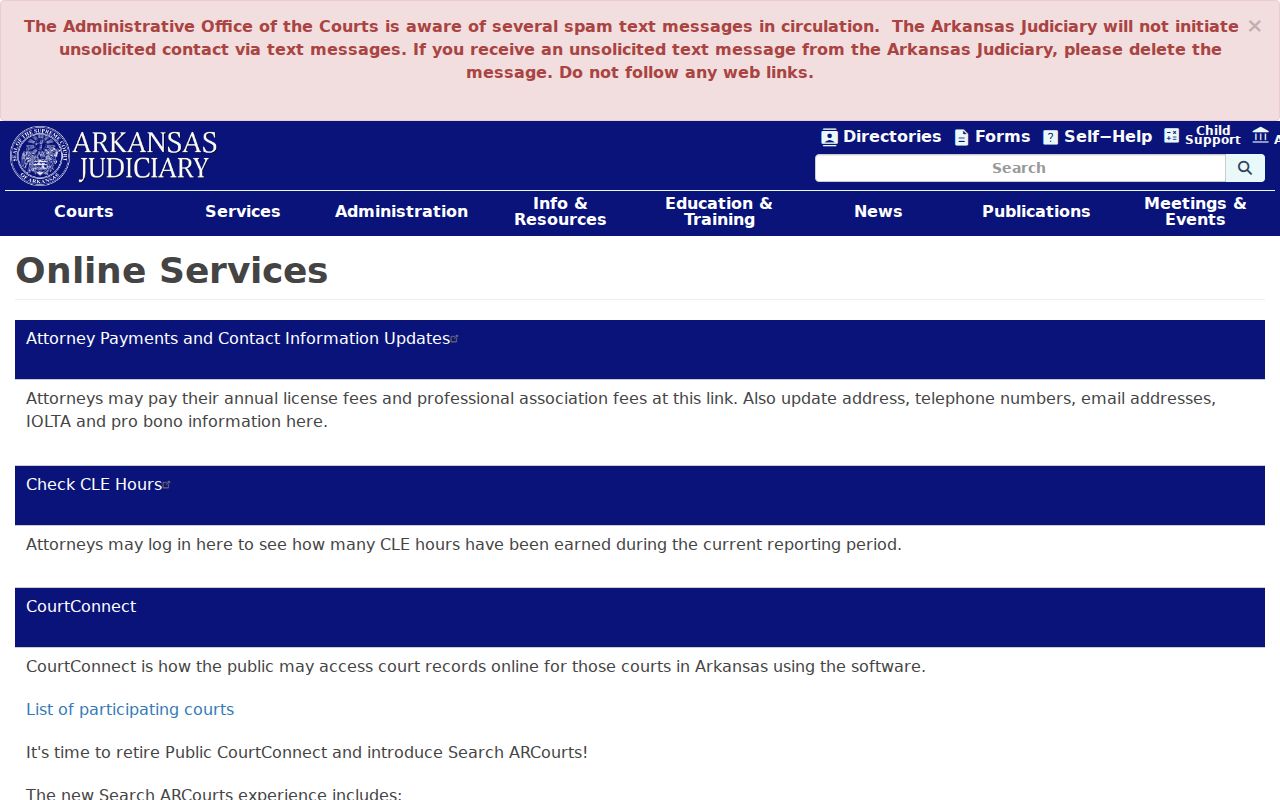
That statewide entry point is useful, but the Newton County clerks remain the source for copies and record-specific answers.
Search ARCourts for Newton Cases
Arkansas Judiciary explains Search ARCourts as the current public interface for case information in courts using Contexte. It replaced the legacy CourtConnect path for those courts. Search by a participant when only a name is known, or use the case-number mode when an exact number is available. Filters may change with the interface, so confirm that the result belongs to Newton County and to the correct court before reading the docket.
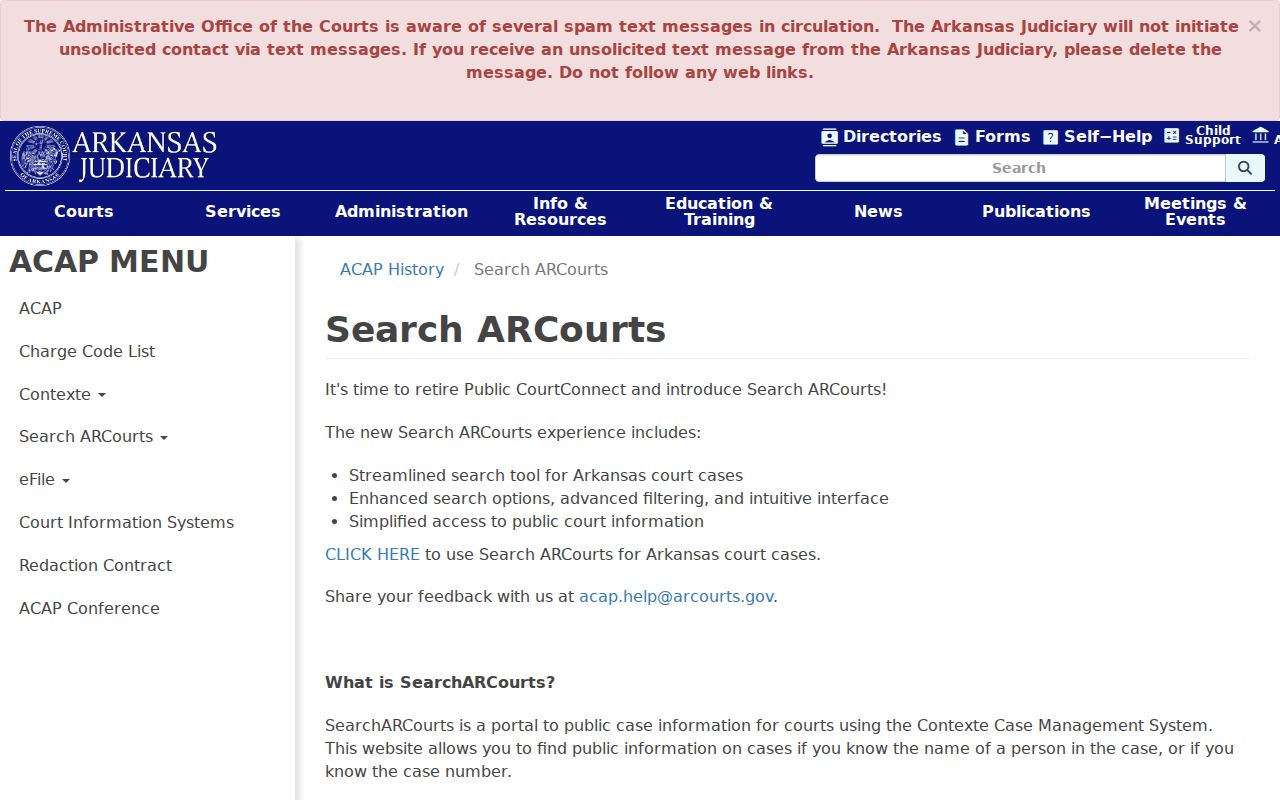
The portal image reinforces the key distinction: it is a case index and document-access system, not a statewide rap sheet.
The Arkansas Judiciary Newton County directory also routes readers directly toward court records.
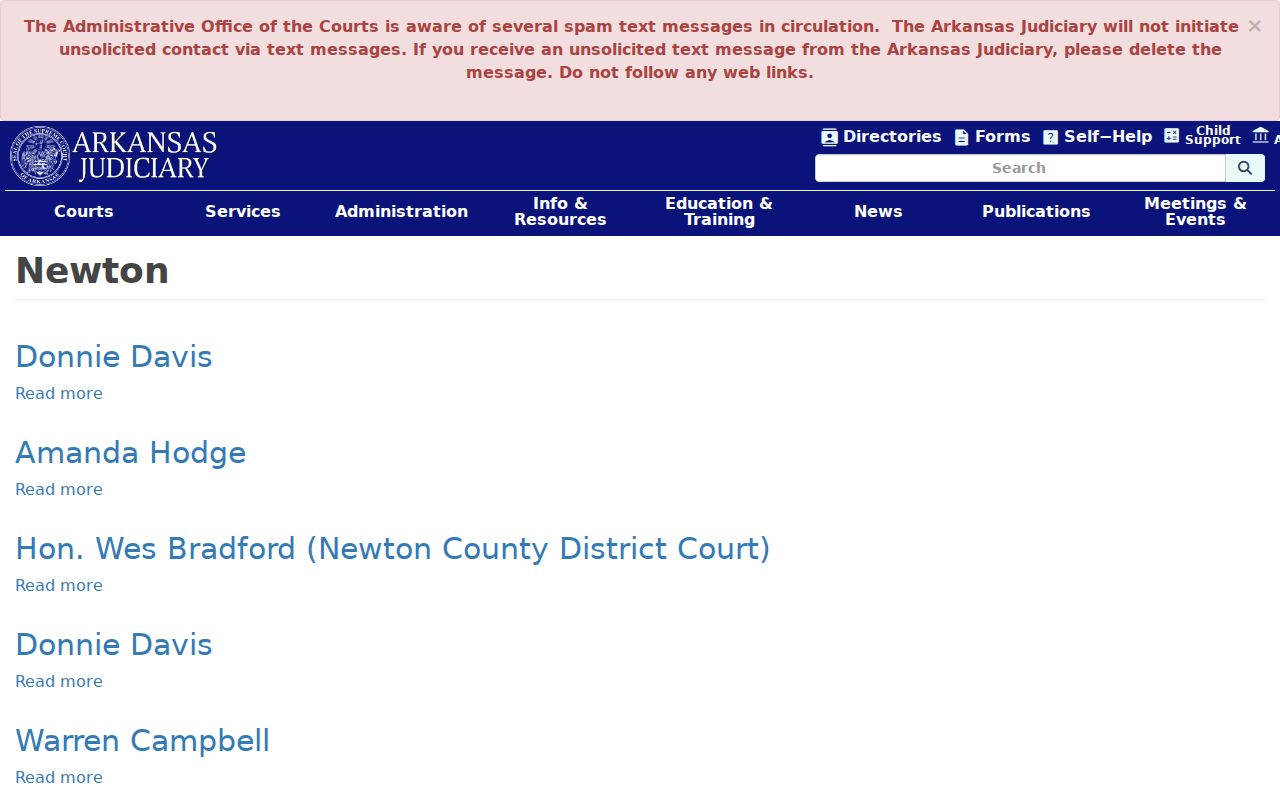
This county-specific directory helps verify that a statewide search result is being followed through the right local office.
How to Search Case Records
Start online, but keep the clerk fallback in view. Search ARCourts can expose public case-level information, filing events, charges, dispositions, hearings, and available documents. Sealed cases, confidential material, juvenile files, older records, and data outside the participating system may not appear.
- Open Search ARCourts and choose participant search or case-number search.
- Enter the known name or exact case number, then apply available county and court filters.
- Confirm whether the result is a Newton County circuit matter or a Jasper Department district case.
- Read events and dispositions in order, without treating the first charge as the final outcome.
- Contact the proper clerk for certified copies, older files, sealed-record questions, or missing documents.
| Field label | Type | Required | Use |
|---|---|---|---|
| Search by Participants | Search mode | No | Use for a person or organization name. |
| Search by Case Number | Search mode | No | Best when the exact court number is known. |
| County or court filters | Dynamic filters | No | Narrow results to Newton County and the proper court. |
| Tips | Help link | No | Provides search and navigation guidance. |
| Document troubleshooting | Help link | No | Addresses pop-up issues when opening public documents. |
Newton County District Case Desk
The Fourth Judicial District Court general-information page identifies the Jasper Department as the local district-court contact. It handles many criminal, traffic, citation, and warrant matters below the felony circuit level. A case that began with a citation or a district bench warrant may stay at this counter rather than in the circuit clerk's felony files.
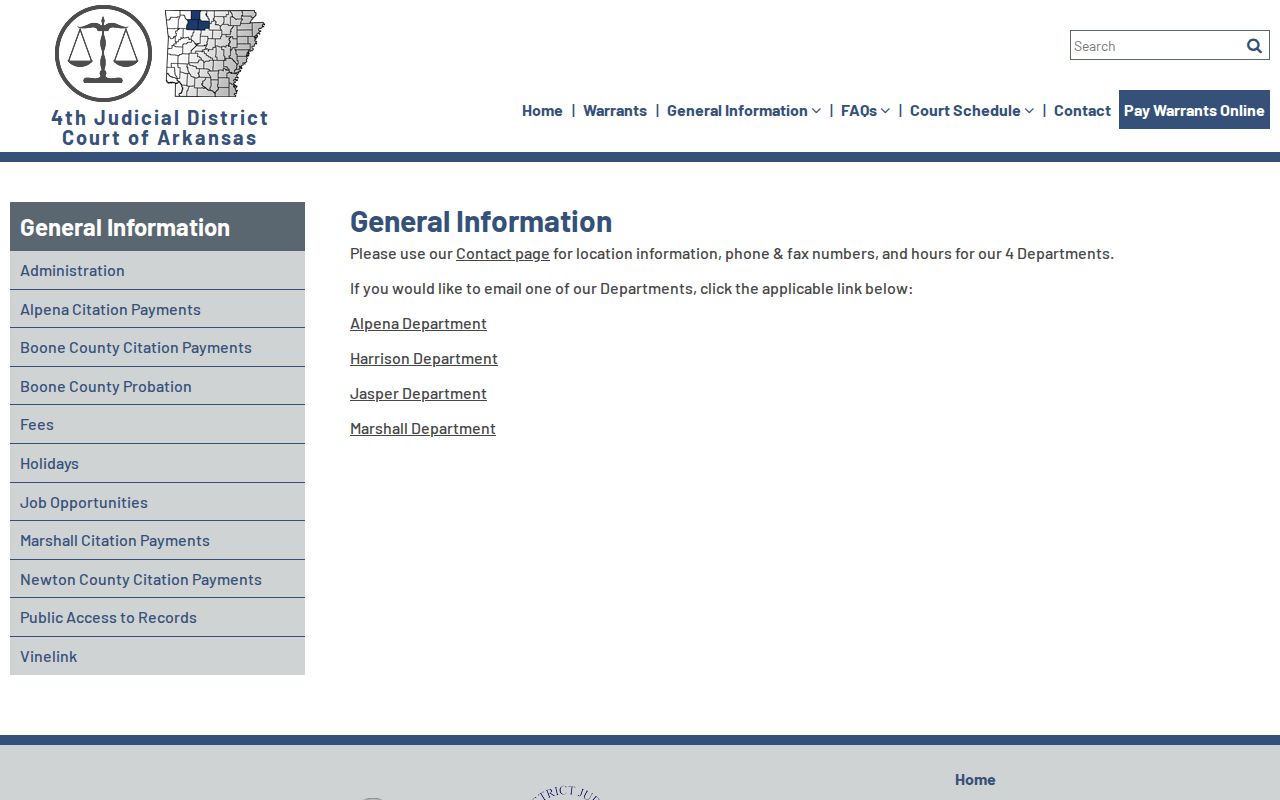
The court information provides a direct fallback when a district matter cannot be resolved through the statewide search.
The district court's official questions page covers common criminal, traffic, and DWI topics.
Those court-specific answers help distinguish payment or appearance questions from a request for the actual case file.
What the Case File Shows
A court file documents the prosecution as filed and the judge's actions. It may begin with a complaint, information, or indictment. The docket then records events such as arraignment, motions, plea settings, hearings, trial activity, and sentencing. A public portal view may not reproduce every paper in the clerk's file, and Arkansas court-access rules can require redaction or withholding.
| Case Number & Court | Identifies the matter and whether it belongs to circuit or district court. |
|---|---|
| Charging Document | States the allegations formally filed by complaint, information, or indictment. |
| Docket Entries | Chronological court events, filings, orders, and settings. |
| Hearing Dates | Past or scheduled appearances shown when public. |
| Disposition & Judgment | Shows dismissal, acquittal, plea, conviction, or another final action. |
| Sentence & Conditions | Records confinement, probation, fines, costs, restitution, or other terms. |
Focus on the most recent disposition for each charge. Prosecutors can amend or dismiss a charge, and one case may end differently from another tied to the same arrest. For the custody event that came first, the separate Newton County arrest history page explains the sheriff and roster channels.
Newton County Court Calendar
The Jasper Department schedule posts Newton County district-court dates for 2026. Listed dates run from January through December, including sessions on January 12, February 2, March 2, April 6, May 4, June 1, July 6, August 3, September 14, October 5, November 2, and December 7. The calendar is useful for planning a call or checking a docket, but it is not a substitute for the notice entered in a specific case.
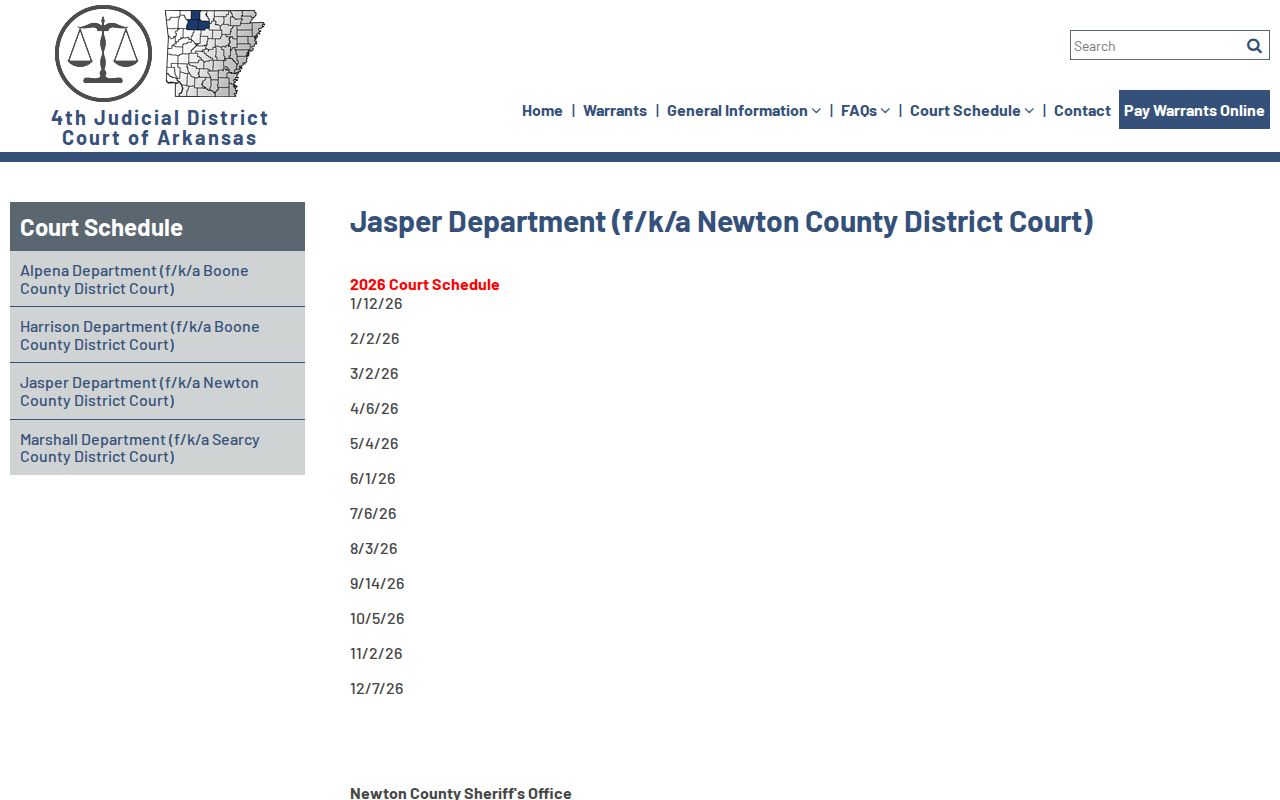
The posted schedule shows why a pending event should be confirmed with Jasper Department before travel.
Stages of a Criminal Case
A criminal court file begins when charges are filed, not merely when an arrest occurs. At arraignment, the court presents the filed charges and receives a plea. Pretrial entries can record motions, discovery disputes, continuances, bond issues, and plea talks. The case then reaches a plea or trial, followed by disposition and, after guilt, sentencing. Some stages may be combined or resolved without a trial.
Case flow: Charges Filed › Arraignment › Pretrial › Plea or Trial › Disposition › Sentencing
Terms need careful reading. A disposition tells how the charge ended. A dismissal ends it without conviction. Nolle prosequi means the prosecutor declined to proceed, while an acquittal is a not-guilty trial outcome. A plea agreement is negotiated but still needs court action. These entries give a fuller account than the booking charge first written at the jail.
Older Newton County Court Records
When a name search returns nothing, first check the spelling, court, and case number. Then call the custodian. The county/circuit clerk is the circuit-file route, while Jasper Department handles its district matters. Ask whether the record predates online coverage, requires an in-person review, or can be copied by mail. Research did not locate a Newton County clerk copy fee, certification fee, parking rule, or public-terminal policy, so confirm those points before visiting.
A missing public result can also reflect a sealed or confidential matter. Under Arkansas sealing procedure, eligible petitions are filed in the circuit or district court where the offense and conviction occurred. Once sealed, a record should not be expected in ordinary public search results. Juvenile information and material restricted under Arkansas Supreme Court Administrative Order 19 may also be unavailable.
Access & Restrictions
Arkansas court records are public only to the extent allowed by court-access rules. Search ARCourts presents public data from participating courts, while the clerk controls official copies. Sealed records, juvenile files, protected victim information, and other confidential material can be withheld or redacted. Arkansas Supreme Court Administrative Order 19 governs access to court records, so the absence of a document from an online docket does not establish that no court file exists.
The Arkansas Freedom of Information Act applies differently to agency records and judicial records. Ask the court clerk for a case file rather than sending a sheriff report request. Conversely, an incident report belongs with the agency that created it. Keeping those custodians separate saves time and prevents a docket search from being mistaken for a full criminal-history check.
Newton County Disposition Changes
The prosecutor's filing choice shapes the public case record. An arrest charge can be amended, divided into several counts, declined, or dismissed. Plea terms may resolve only some counts. The final judgment and sentence therefore matter more than the first allegation. Newton County lies in the Fourteenth Judicial District prosecutorial system, and appointed representation comes through Arkansas Public Defender Commission District 14, but neither office replaces the clerk as record custodian.
Read each count from filing through its last disposition. If a docket uses terms such as recognizance, capias, restitution, or Act 346, connect the term to the event. Recognizance is release based on a promise to appear. A capias is a court order to take someone into custody. Act 346 is an Arkansas first-offender mechanism that may avoid a conviction when its requirements are met. The clerk can supply the official judgment when a portal summary is too thin.
Sentence entries may list confinement, probation, fines, court costs, restitution, or more than one condition. District-court probation payment questions route to Jasper Department, while adult state probation and post-release supervision generally involve the Arkansas Division of Community Correction. A revocation filing can create a new public event in Search ARCourts even though no public Newton County probation-status database exists. For that reason, check the docket for filed revocation activity and call the responsible supervision office for current instructions. Do not infer present custody from an old sentence line. County jail custody, state prison custody, and community supervision are separate statuses, each maintained in a different system.